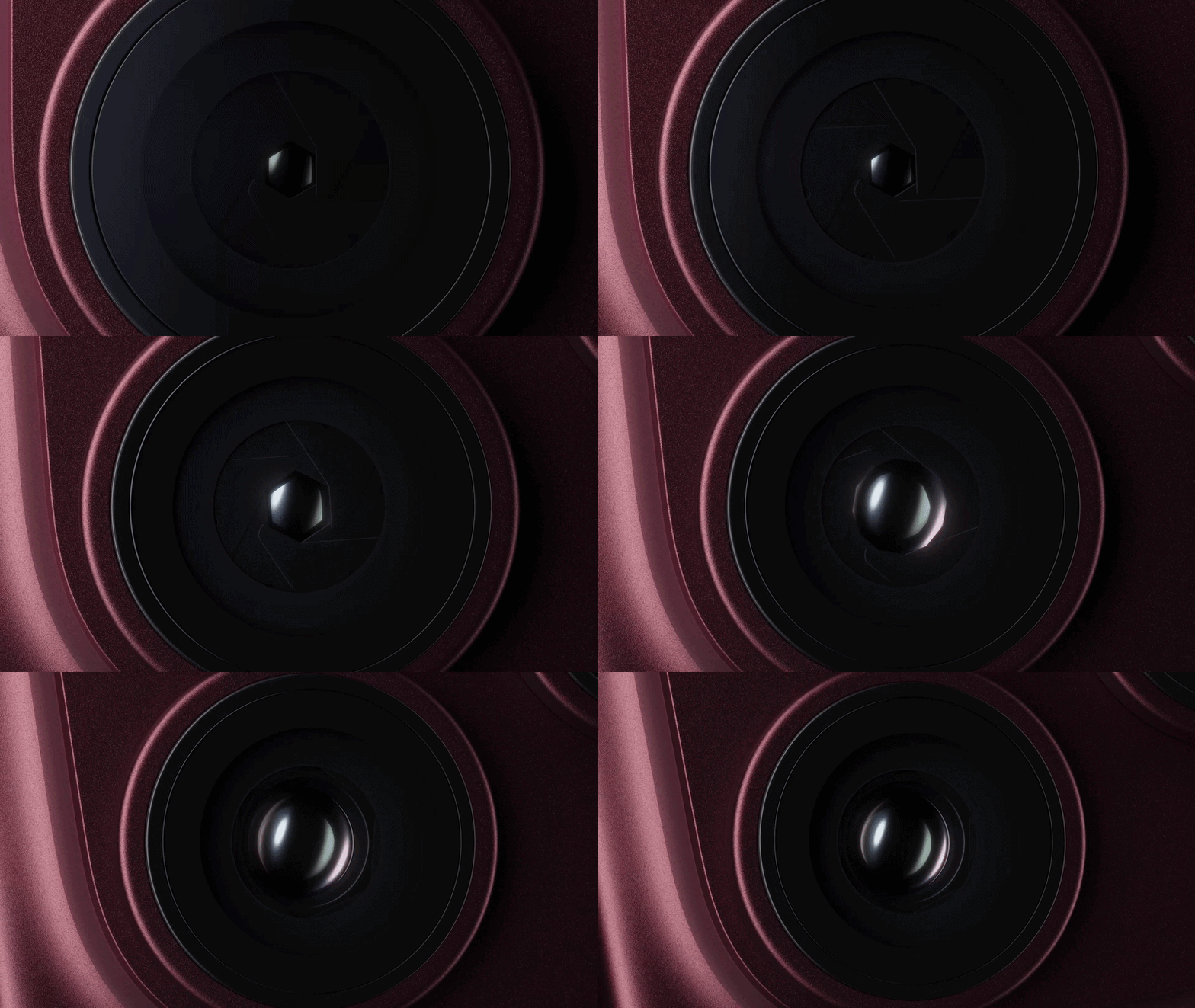
I don't want to start a new thread, so I'm putting this here. I've been seeing ads for the "revolutionary" new iPhone 18 Pro, with a variable aperture camera lens. My first thought was "haven't
all cameras always had that?". After all, the detailed info for every phone picture I've ever taken lists the f-stop, and it's not always the same. So I looked into it.
It turns out that most phone cameras use a fixed aperture. Some of the Samsung models I've owned had a couple of lenses with different apertures, but the variation was small. Of course, real cameras (such as DSLRs) have a large aperture range, typically from f/1.8 to f/22. The low number is for low-light pictures (the figure is actually an inverse, so 1.8 is really the larger value of 1/1.8, and 22 is the smaller value of 1/22), while the high number is for a long "in-focus" range (depth of field). But according to this article...
Spoiler alert: because it's not necessary!

www.digitalcameraworld.com
it's mostly a marketing gimmick. That's because real cameras have large sensors (36 x 24 mm), while phone cameras have tiny sensors (6 x 4 mm). What that means regarding apertures, is that even at the largest opening of f/1.8 (or f/1.5 in the case of the iPhone 18 Pro), the in-focus range is still high. So then there's no need for smaller apertures. In fact, the 18 Pro only goes up to f/4 (while real cameras go to f/22). The variability is small, and pointless.
But you might be wondering, what about the portrait mode, where the background is blurry? Because of the small sensors, phone cameras can't do that via the lens. But it
can do it with software, which is what most phone cameras use. Then I guess it's no surprise that a flagship phone is using dubious technology for marketing purposes.